Shenzhou-24 Takes Pakistan's First Astronaut to China's Space Station, First Foreigner on Board
Muhammad Zeeshan Ali, a Pakistani Air Force pilot, flies with two Chinese crew members on the first joint flight of China's human spaceflight program
By gnews Newsroom 3 min read
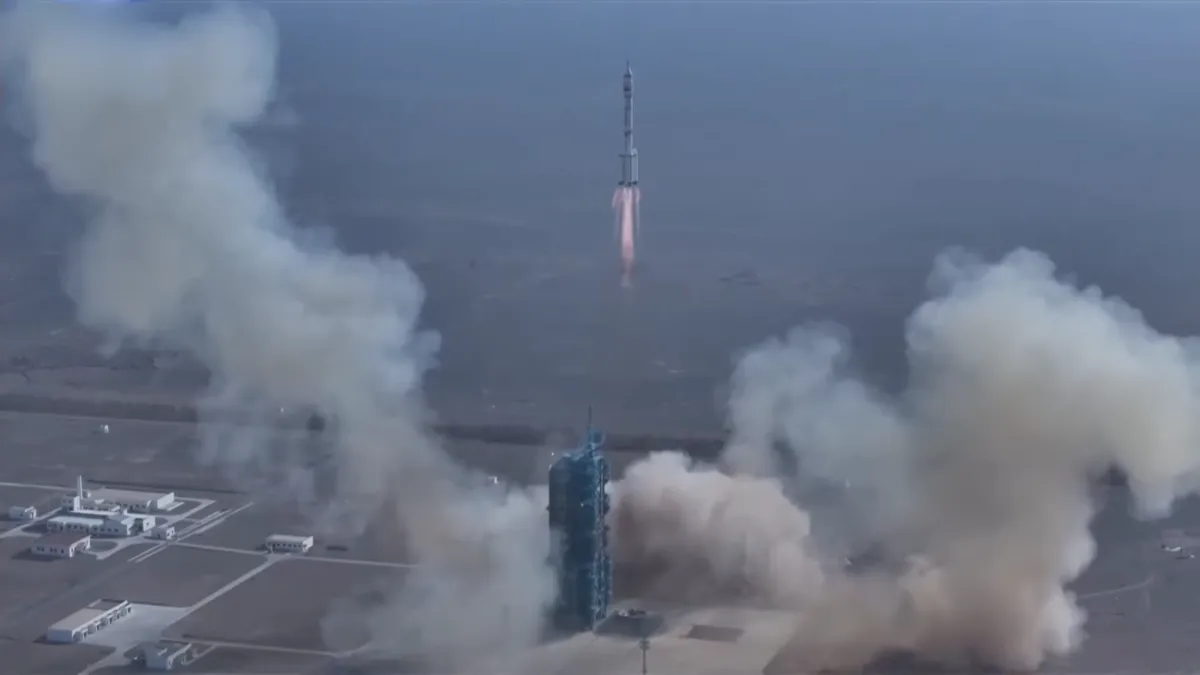
China launched the Shenzhou-24 mission with Pakistan's first astronaut on board. Muhammad Zeeshan Ali, 40, a Pakistani Air Force pilot, lifted off at 9:18 p.m. Tuesday (24) Brasília time (BRT, UTC-3) from the Jiuquan Satellite Launch Center in northwestern China. He is the first foreigner to join a crew sent to Tiangong, China's space station.
The spacecraft rode a Long March 2F rocket and, about ten minutes later, separated from the launcher and entered the planned orbit, according to the China Manned Space Agency (CMSA). Docking with the station was confirmed at 0:56 a.m. Wednesday (25) Brasília time by CMSA and Suparco, Pakistan's space agency. The three crew members then entered the station and posed for photos with the Shenzhou-23 astronauts, who were already there.
Who is on the crew
Alongside Ali, Chinese astronauts Tang Hongbo, 51, and Wu Yi, 39, are flying. It is the first space trip for both Ali and Wu. Tang had already flown twice and, according to state broadcaster CCTV, becomes the first astronaut to visit Tiangong three times.
On the eve of the launch, Tang said at a press conference that language, cultural, and psychological differences made joint training difficult, but that efforts from both sides were paying off. Ali said he hopes to see cooperation grow, with multiple joint flights and, in the future, missions to the Moon, Mars, and beyond.
The Xinhua news agency reported that the mission includes more than 90 scientific experiments and technology tests. Ali's participation will be brief: he will conduct an experiment with photosynthetic cyanobacteria and return to Earth on the Shenzhou-23 spacecraft. The return date has not been announced.
Why the flight matters
It is the first joint flight of Chinese and foreign astronauts in the history of China's human spaceflight program. The trip is part of an agreement signed by the two countries in February 2025. Pakistani President Asif Ali Zardari and Chinese leader Xi Jinping exchanged congratulatory letters, according to Zardari's office.
Pakistani Prime Minister Shehbaz Sharif celebrated on X. "This is not the journey of one astronaut, but the journey of 240 million Pakistanis," he wrote. In Islamabad, students and scientists watched the launch in the early morning at the Suparco headquarters auditorium, with the national anthem playing in the background, according to Al Jazeera.
What comes next
Pakistan wants to go beyond hitching a ride. Suparco Chairman Muhammad Yousaf Khan said the country aims to reach the Moon by 2035 and that the first step is a lunar rover scheduled to fly in 2028. Planning Minister Ahsan Iqbal said "that day will come" when asked if Pakistan could send astronauts on its own.
China, for its part, plans to send astronauts to the Moon by 2030. NASA is working toward a 2028 target for its crewed landing. With Tiangong receiving foreigners, Beijing is now using the station as a tool for international cooperation. No Brazilian participation has been announced in the program.
Sources: Associated Press (ABC News), Associated Press (NBC News), Al Jazeera
Frequently asked questions
Who is on board Shenzhou-24?
Pakistani Muhammad Zeeshan Ali, 40, and Chinese astronauts Tang Hongbo, 51, and Wu Yi, 39.
How long will the Pakistani astronaut stay in space?
His mission is short. Ali will return to Earth on the Shenzhou-23 spacecraft, but the return date has not been announced.
Why is the Shenzhou-24 mission unprecedented?
It is the first joint flight of Chinese and foreign astronauts in China's human spaceflight program, the result of an agreement signed with Pakistan in February 2025.